

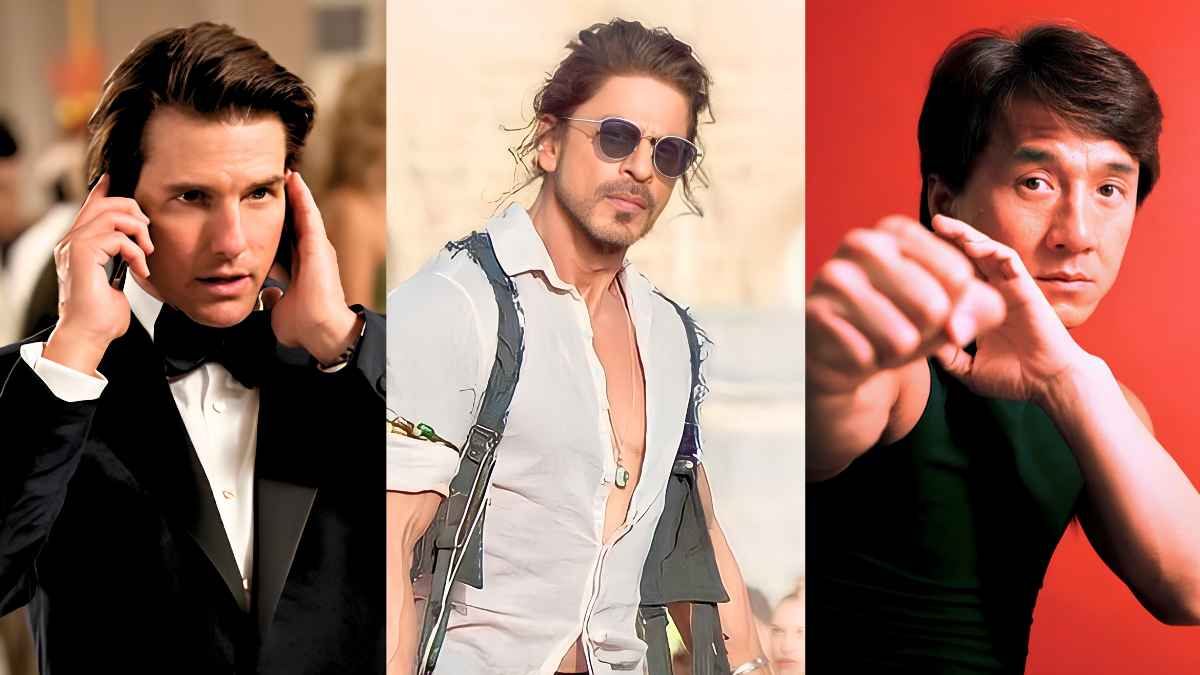
From Tom Cruise and Shah Rukh Khan to Jackie Chan and the newer generation, the answer depends on what exactly makes a movie star “big”.
Who is the biggest movie star in the world?
It sounds like a simple question. In reality, it is one of the most difficult questions in cinema to answer.
There is no universally accepted measurement for movie stardom. Box-office earnings tell one story. International recognition tells another. The ability to open a film on the strength of a name alone tells another. And then there is something harder to measure – the emotional connection between a star and audiences across countries and generations.
That distinction matters because the world’s biggest actor by cumulative box-office gross is not necessarily the world’s biggest movie star.
Guinness World Records, for example, currently lists Samuel L. Jackson as the highest-grossing actor at the global box office in leading roles, with his 57 lead films having accumulated more than $14.6 billion worldwide as of January 26, 2026. Much of that total comes from ensemble franchises including the Marvel films.
That is an impressive record. But it does not automatically answer the question of who has the strongest individual movie-star pull.
Tom Cruise and the old-fashioned definition of a movie star
If movie stardom is defined as the ability to put your name above the title and make audiences around the world turn up for a theatrical experience, Tom Cruise remains one of the clearest examples.
Cruise has spent more than four decades building a career around films in which his presence is central to the proposition. The phenomenon reached another level with ‘Top Gun: Maverick’, which ultimately grossed about $1.5 billion worldwide.
The significance of ‘Top Gun: Maverick’ was not simply its gross. It demonstrated that an established actor could still drive a large-scale theatrical event with his own identity at the centre of it.
Cruise’s ‘Mission: Impossible’ films have similarly turned Ethan Hunt into one of modern cinema’s most recognisable characters. ‘Mission: Impossible – The Final Reckoning’ finished with approximately $599 million worldwide in 2025.
Even as the economics of filmmaking have changed, Cruise has continued to be identified with theatrical cinema. A recent GQ profile described his enduring commitment to the big-screen experience and noted the $1.48 billion worldwide success of ‘Top Gun: Maverick’.
His recognition is also unusually broad. YouGov’s current UK data records 100% fame for Cruise, meaning virtually everyone surveyed has heard of him.
That makes Cruise a particularly strong candidate when “biggest movie star” means worldwide name recognition combined with a long record of theatrical films built around a leading man.
Then there is Shah Rukh Khan
But the question becomes much more complicated when the definition of movie stardom moves beyond Hollywood.
In India, Shah Rukh Khan represents a different model of global celebrity. His appeal was established through Hindi cinema and then carried across borders through the South Asian diaspora and audiences who discovered Bollywood through television, music and increasingly digital platforms.
TIME described Khan in 2025 as an international icon whose global impact has been sustained across more than three decades of cinema. The publication also noted the importance of the South Asian diaspora in spreading his work internationally.
His 2023 releases demonstrated the scale of that continuing theatrical appeal. ‘Pathaan’ and ‘Jawan’ both crossed the $100 million worldwide mark. Forbes reported that ‘Jawan’ had reached $120.6 million globally within 20 days of release.
The film ultimately became one of the biggest Hindi-language theatrical successes ever recorded, with reported worldwide grosses of more than ₹1,100 crore.
There is another important dimension to Khan’s stardom. His appeal is not confined to one genre. Over his career he has been associated with romance, drama, comedy and action, while his public identity has remained closely connected with Bollywood itself.
That makes Shah Rukh Khan an important part of any serious discussion about the world’s biggest movie star.
Jackie Chan offers another definition of global stardom
Jackie Chan illustrates yet another route to worldwide recognition.
Unlike stars whose international success depends primarily on one major film industry, Chan built recognition through Hong Kong cinema before becoming a major Hollywood presence. His name, physical comedy and action style became recognisable to audiences who did not necessarily speak either Cantonese or English.
Current YouGov data in the United States gives Chan a 96% fame score and a 72% popularity score among its surveyed population. In the UK, his fame score is 95%.
Those figures do not measure global popularity as a whole, but they demonstrate how unusual Chan’s cross-generational recognition remains in major Western markets.
His career also illustrates why box-office totals alone can be misleading. A star can become globally recognisable through decades of cultural exposure even when individual films do not always produce the largest worldwide grosses.
What about the newer generation?
The definition of movie stardom is changing again.
Modern audiences encounter actors through cinema, streaming platforms, social media, franchises, gaming, music and celebrity culture. A performer can therefore have enormous global recognition without necessarily possessing the traditional ability to open an original theatrical film.
The current industry itself recognises this distinction.
Forbes’ 2026 assessment of the highest-paid actors of 2025 noted concerns within Hollywood about the changing value of traditional movie stardom. The report pointed out that even major names are no longer automatically enough to guarantee a commercial success.
At the same time, some stars continue to command enormous theatrical attention when attached to the right material.
This is why the phrase “biggest movie star” should not be confused with “highest-grossing actor”.
So who is the biggest?
The honest answer is that there is no single objectively verifiable biggest movie star in the world.
If the measurement is cumulative worldwide box office in leading roles, Guinness currently points to Samuel L. Jackson.
If the measurement is contemporary theatrical star power built around an individual leading man, Tom Cruise has an unusually strong case, particularly after the extraordinary worldwide performance of ‘Top Gun: Maverick’.
If the measurement is the cultural reach of a non-Hollywood star whose name has become synonymous with an entire national film industry, Shah Rukh Khan belongs firmly in the conversation, with his recent blockbusters demonstrating substantial international theatrical reach.
If the measurement is cross-generational recognition across Eastern and Western popular culture, Jackie Chan presents another compelling example.
And that may actually be the most interesting conclusion.
The world’s biggest movie star is not necessarily the actor with the largest box-office number, the highest salary or the greatest number of social-media followers.
Movie stardom is ultimately a combination of recognition, audience connection, longevity, cultural influence and the ability to make a film feel like an event simply because a particular name is attached to it.
By that broader definition, the debate is not really between Hollywood and Bollywood.
It is about what the word star means in the first place.